
Frame
Whose point of view leads this account?
Identify its sources, assumptions, date, scale, and perspective. Test possible bias rather than presume it.
Civics Remix · Our Method
AI can summarize a river. It cannot tell you whether the drain on your walk to the water is blocked. Fellows question what AI leaves out, then go to the curb and record what satellites and models cannot see.
Our aim: not a better prompt, but a more accountable public record.
Developed by Isabella Getahun, Founder / Student Leader, Civics Remix
A satellite cannot see grass growing across a curb opening.
Our fellows did.
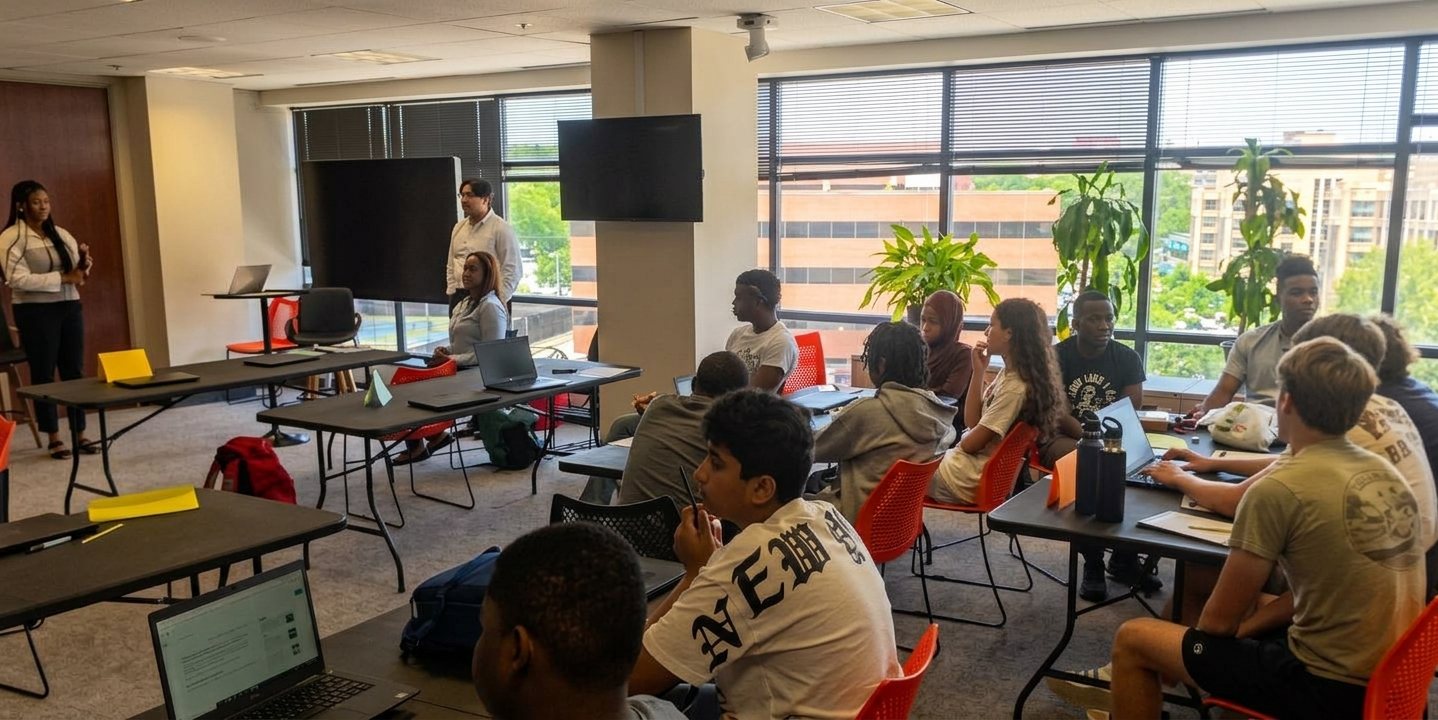
Isabella Getahun presenting the Civics Remix Filters to a group of students.
What AI misses
We asked Google’s AI and ChatGPT about the Anacostia, with open prompts, flooding prompts, and more guided ones. Across the five answers we saved, the pattern held. They covered history, sewers, tunnels, tides, and property risk. None reached the curb.
With enough prompting you could probably steer an answer toward drains. You would have to know to ask. That is the skill the Civics Remix Filters teach: noticing what an answer leaves out.
Google says the data gap is real. Its own flood forecasting team explains that it had a huge amount of data on river floods and almost none on urban flash floods, because sensors that watch urban flash flooding are unusual. Google has since launched an urban flash flood forecast to work around that gap. A forecast is still not a field record of what is blocked at a given curb. Read Google’s explanation and its flash flood forecasting post.
The Civics Remix Filters
The Civics Remix Filters pair critical AI inquiry with Harkness dialogue, history, watershed science, and civic practice. Four stages turn a question into evidence, and evidence into a responsible next step.
Find it.
Use four filters to spot a possible gap, and test whether the evidence supports it.
Build it.
Test the account against sources, community knowledge, science, and field observation.
Send it.
Turn reviewed evidence into data, public comment, a FOIA request, or a finding shared forward.
Measure it.
Record what happened, what changed, and what the next team can learn.
Start with a baseline. Capture the original account and decide what improvement would look like before acting. Afterward, compare the result with that starting point. A suspected gap is a question to investigate, not proof of bias or wrongdoing.
The FACT filters
Before deciding what an AI answer gets wrong, look closely at what it says, where it came from, and what it may not be able to show. Use all four filters, and treat a suspected omission as a question to test.
Whose point of view leads this account?
Identify its sources, assumptions, date, scale, and perspective. Test possible bias rather than presume it.
Who or what is missing?
Save the exact passage. Name a missing person, place, time, or condition, and what evidence could test the omission.
Why could the missing piece matter?
Explain what understanding or decision may be affected, who bears the stakes, and what is still uncertain.
Where is the evidence?
Check the source, date, method, permissions, and limits. Separate observation from inference and unknowns.
Investigate
REFRAME is the investigation loop. Students compare the original account with evidence from history, water science, primary sources, community knowledge, and the world beyond the screen.
Capture the original, prompt, date, and settings.
Use FACT; define what would confirm or disprove the gap.
Gather missing evidence through approved observation and research.
Use the names and terms people choose.
Build around verified evidence and its limits.
Compare the revised account with the baseline.
Keep the reviewed finding, sources, and permissions.
The goal isn’t simply to point at a blind spot. It’s to investigate it, and to make a public record the evidence can support.
Contribute
A civic artifact can carry learning beyond the classroom: data, public comment, a FOIA request, or a documented finding shared forward. The four rungs of the action ladder are proposed; start on the lowest one that fits.
A: Attain. Prepare the evidence, a clear request, the responsible recipient, and any needed allies, access, resources, or permissions.
C: Conduct. Choose an action that fits the evidence and stakes. Start with the lowest appropriate step, and get required approval before external sharing.
T: Tell. Record what the team did, the immediate response, and when to review again. Pass the action record to IMPACT.
Correct or qualify your own account, map, or story. Keep the dated change and its evidence.
Send a specific, approved ask to the responsible owner. Record receipt and a review date.
Bring affected people and decision makers into a documented review. Preserve disagreement.
Create an authorized alternative or practice. Name its owner and test implementation.
Follow through
Count activities separately from outcomes. Look at the account, an organization’s practice, and whether people can use or access the result.
What happened, who did it, when, and toward what objective? Separate planned, attempted, completed, and adopted actions.
Who was reached, who benefited, and what changed against the baseline? Consider persistence and unintended effects.
Keep dated sources, versions, permissions, action records, responses, and comparisons. Protect private records.
Use results and community feedback to decide what to continue, improve, stop, or try next. Assign an owner.
Ask an independent, qualified reviewer what the evidence supports and what remains unresolved.
Share tested cases, reusable materials, evidence standards, and a measurement plan. Record local adaptations.
If a new gap appears, return to FACT.
The Civics Remix Filters in the field · Summer 2026
Can Washingtonians reach the Anacostia Riverwalk Trail on foot when it rains?
Twenty-five fellows from all eight wards investigated flood chokepoints on walking routes from the Minnesota Avenue, Anacostia, and Navy Yard Metro stations to the trail in Wards 6, 7, and 8. They tested what an AI answer could show against history, watershed science, and street-level observation.
Fellows documented drainage openings with grass and debris, conditions invisible from above, and created a fragility index from observed conditions. The index records what they saw. It is not a prediction of future flooding.
Read the Summer 2026 field record ↗ Open the full StoryMap ↗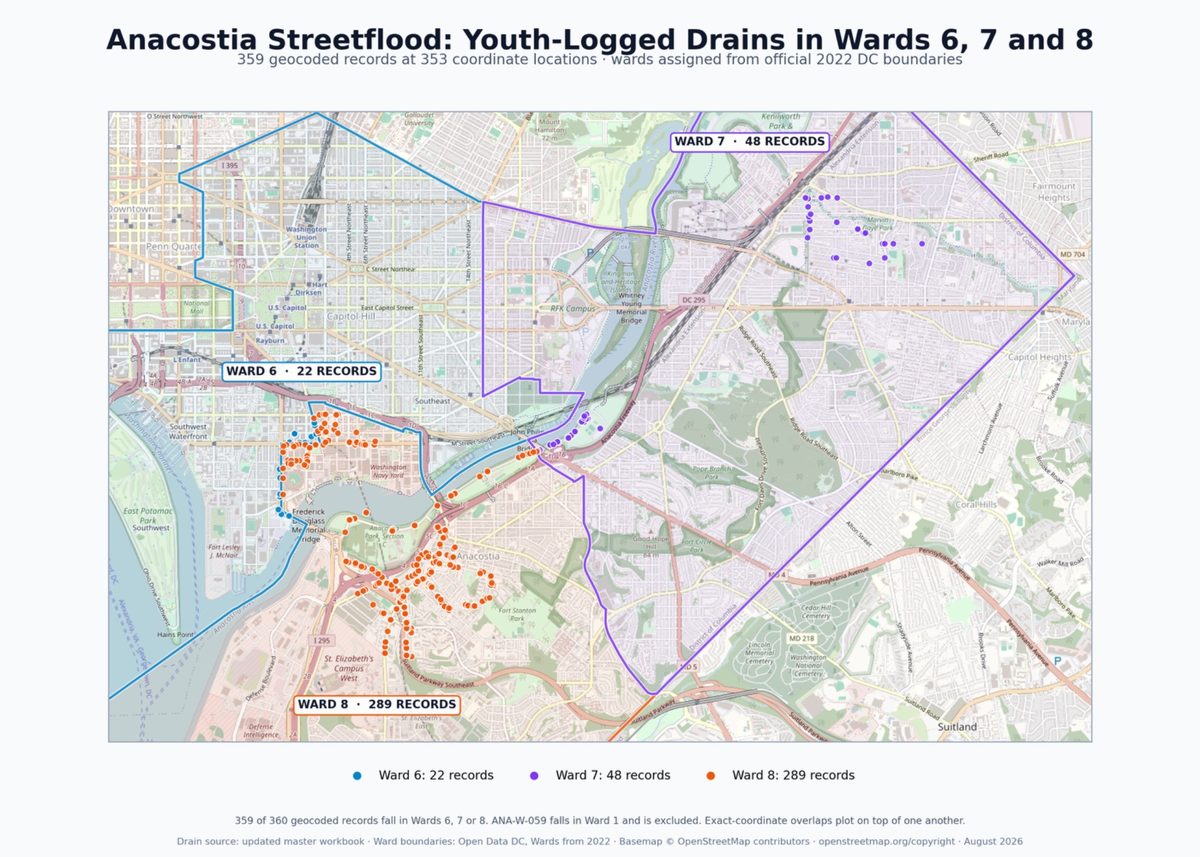
“If the communities are not healthy, the river could never be healthy.”Dennis Chestnut, former executive director of Groundwork Anacostia River D.C. · UDC News, May 10, 2026
Bring the filters to your community
Explore the classroom resources, use the handout, or ask us about bringing the Civics Remix Filters to a school or youth program.
The handout may be printed and shared unaltered with attribution. Full curriculum use, facilitator training, and materials require a license.