1

Young Rosa

📍 Pine Level, Alabama — 1920s
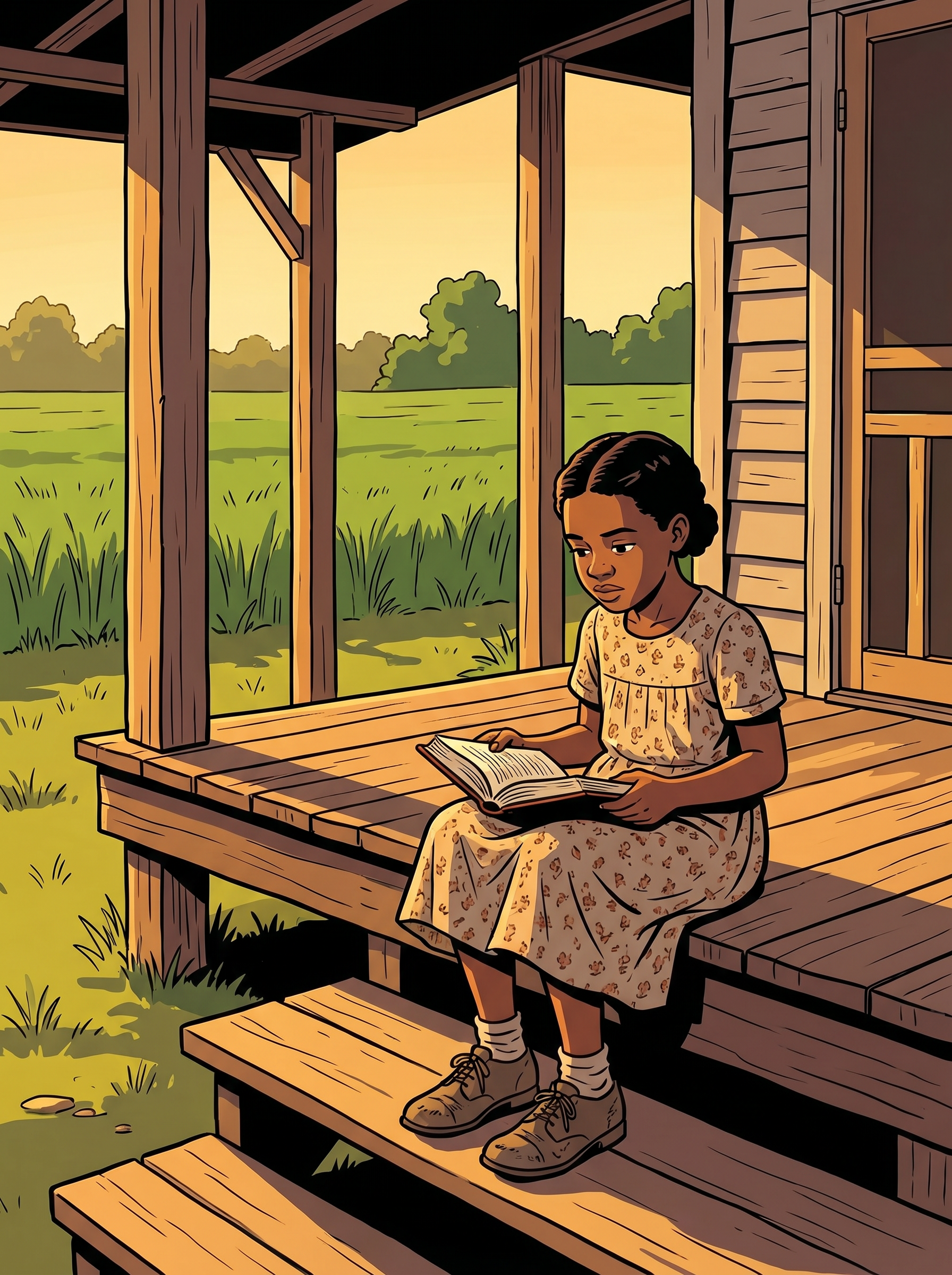
Young Rosa growing up in Alabama

📖 The Story

Rosa Louise McCauley was born February 4, 1913 in Tuskegee, Alabama. She grew up in Pine Level, raised by her grandparents. Jim Crow laws were everywhere — separate schools, water fountains, restaurants, and buses. Her grandfather stood on the porch with a shotgun to protect the family from the KKK.

Young Rosa: "Why do we have to sit in the back, Grandma?"
Grandmother: "Because some people made an unfair rule. But an unfair rule is not the same as the truth."

🗓 Timeline

1913 Rosa born in Tuskegee, AL
1920s Grows up under Jim Crow
1932 Marries Raymond Parks
1943 Joins the NAACP
1955 Attends Highlander Folk School

Discussion Questions

Level 1 — Who & What · Write your thoughts below. Your answers stay private on your device.
1 What unfair rules did Rosa see when she was a child? Find at least two from the chapter.
🔒 Your answer is not saved to any server — it stays on your device only.
2 Who in Rosa's family taught her she was just as good as anyone else? Name two people.
🔒 Your answer is not saved to any server — it stays on your device only.
Chapter 1 of 7
2

Unfair Rules

📍 Montgomery, Alabama — 1955
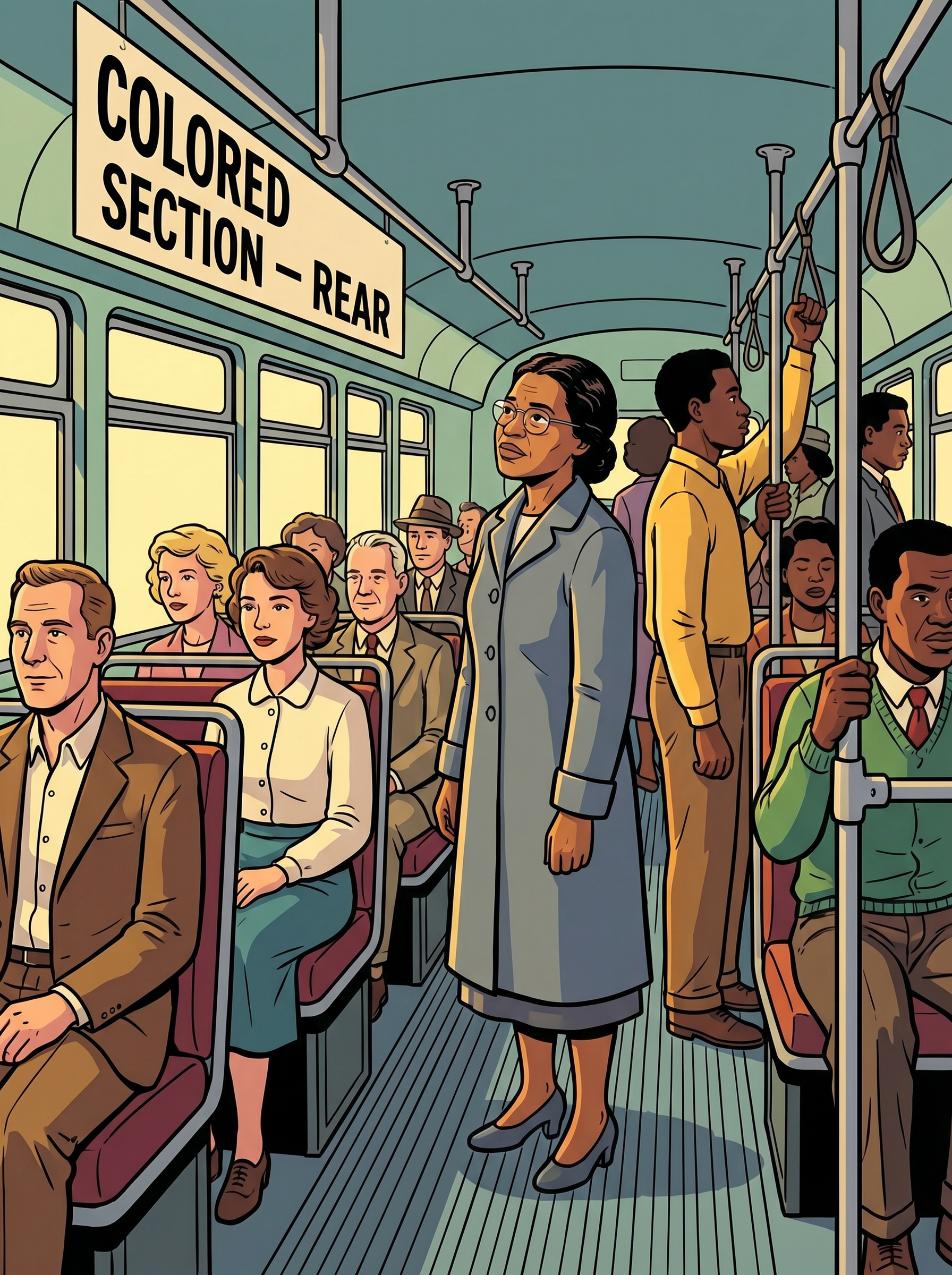
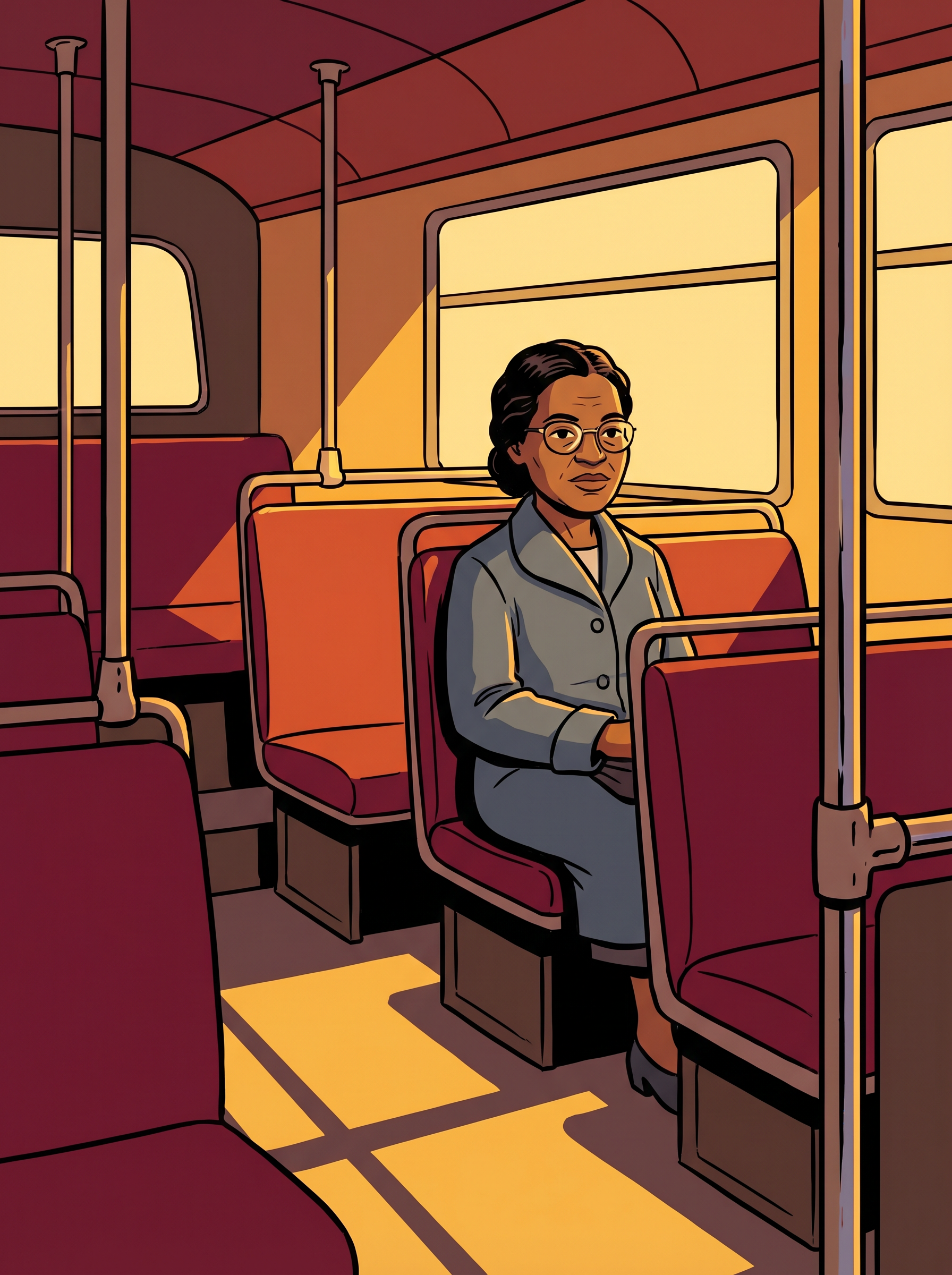
Segregated bus rules in Montgomery

📖 The Story

Montgomery's buses had a rule: Black passengers had to sit in the back. Front rows were for white passengers only. If the bus got full, Black passengers had to give up their seats even if no white passenger was standing.

Rosa Parks was not just a tired seamstress — she was a trained civil rights activist, secretary of the Montgomery NAACP for 12 years, and had studied nonviolent resistance at Highlander Folk School in Tennessee. She knew exactly what she was doing on December 1, 1955.

Bus Driver: "You people know the rules. Move to the back or get off."
Rosa (thinking): "I have followed this rule my whole life. But a rule that is wrong is not a rule worth following."
⚠️ Notice Many people learned that Rosa Parks was just "a tired old woman who wanted to sit down." That story leaves out almost everything important.

Discussion Questions

Level 1 — Who & What · Write your thoughts below. Your answers stay private on your device.
1 Some people say Rosa was just a tired woman who wanted to sit down. What did she really do for 12 years before that day?
🔒 Your answer is not saved to any server — it stays on your device only.
2 Why might some people like the "tired woman" story better than the "trained activist" story? Whose voice gets quieter when we tell the easy version?
🔒 Your answer is not saved to any server — it stays on your device only.
Chapter 2 of 7
3

The Moment

📍 Cleveland Avenue Bus — 6:00 PM, December 1, 1955
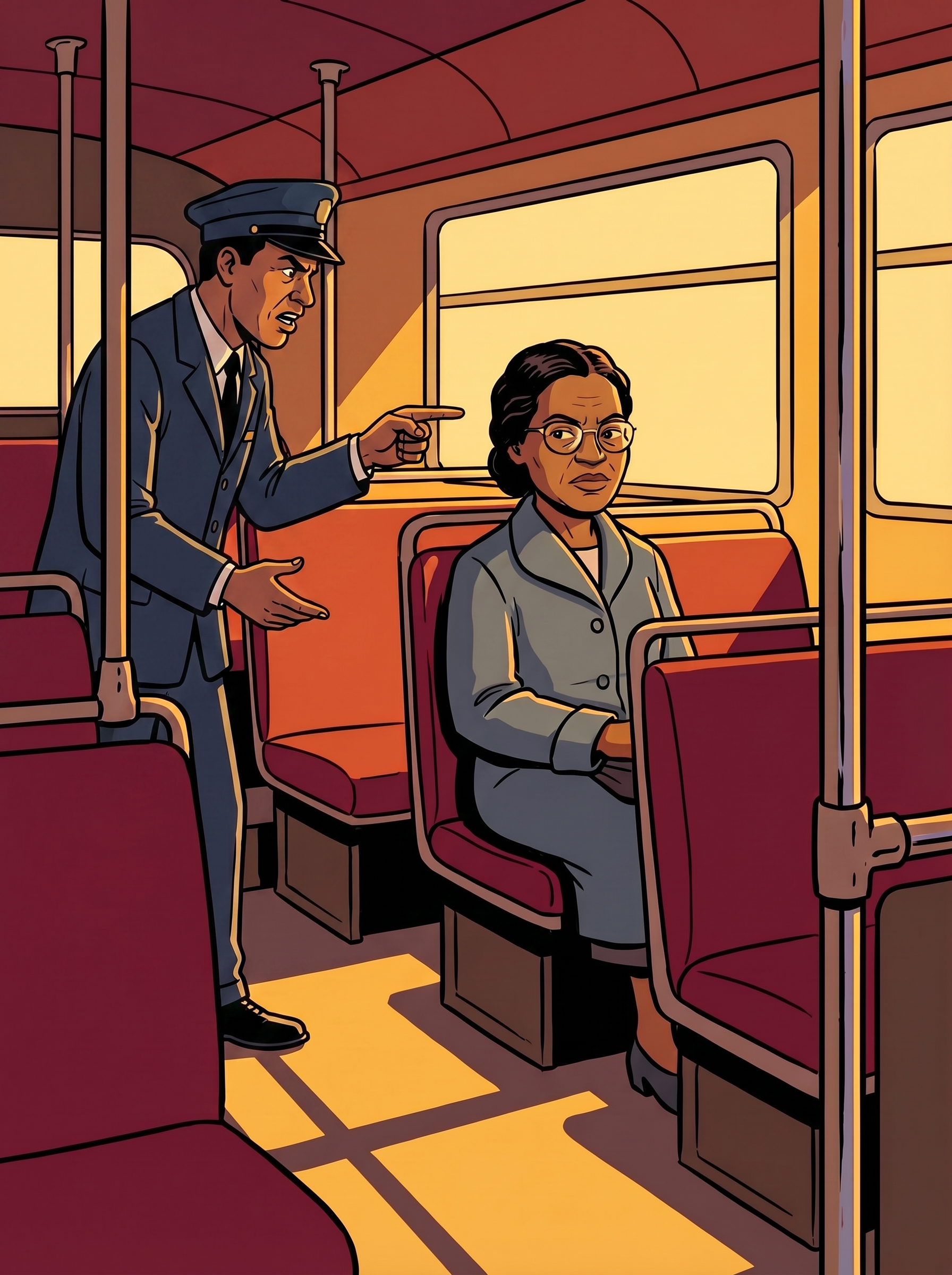
Rosa Parks refusing to give up her seat

📖 The Story

Rosa boarded the Cleveland Avenue bus after a long day of work as a seamstress. She sat in the first row of the "colored" section. When the bus filled up, driver James Blake told Rosa and three other Black passengers to move back so a white man could sit. The others moved. Rosa did not.

"People always say that I didn't give up my seat because I was tired, but that isn't true. The only tired I was, was tired of giving in."
— Rosa Parks
Driver Blake: "Are you going to stand up?"
Driver Blake: "Well, I'm going to have you arrested."
Rosa Parks: "You may do that."

Discussion Questions

Level 1 — Who & What · Write your thoughts below. Your answers stay private on your device.
1 Three other Black passengers stood up when Driver Blake told them to move. What did Rosa do that was different from the others?
🔒 Your answer is not saved to any server — it stays on your device only.
2 What had Rosa learned and practiced before December 1, 1955 that helped her stay sitting down?
🔒 Your answer is not saved to any server — it stays on your device only.
Chapter 3 of 7
4

The Boycott

📍 Montgomery, Alabama — December 5, 1955
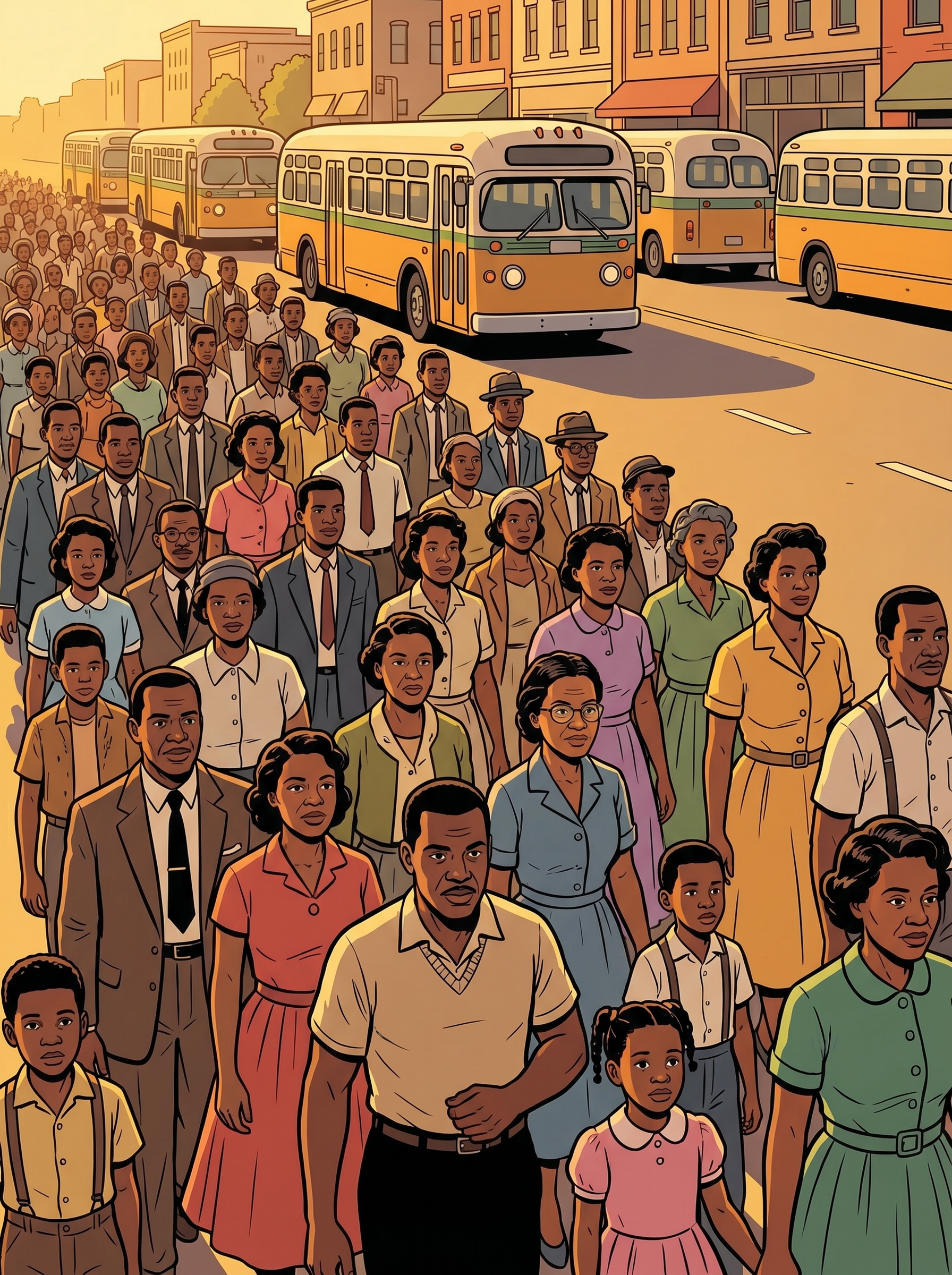
The Montgomery Bus Boycott

📖 The Story

The night Rosa was arrested, Jo Ann Robinson — a professor and NAACP leader — stayed up all night and printed 52,500 flyers and passed them through the city. The message was simple:

"Don't ride the bus to work, to town, to school, or any place Monday, December 5."

On Monday morning, the buses were empty. 40,000 Black residents walked, carpooled, rode mules, and stayed home. The boycott lasted 381 days. On November 13, 1956, the U.S. Supreme Court ruled in Browder v. Gayle that bus segregation was unconstitutional. The community had won.

Discussion Questions

Level 1 — Who & What · Write your thoughts below. Your answers stay private on your device.
1 What happened in the four days between Rosa's arrest on December 1 and the bus boycott on December 5? Name two things.
🔒 Your answer is not saved to any server — it stays on your device only.
2 The boycott would not have worked with just Rosa. Name two other people in the chapter who helped, and what each one did.
🔒 Your answer is not saved to any server — it stays on your device only.
Chapter 4 of 7
5

Legacy

📍 Rosa's Legacy — A Life of Continued Service
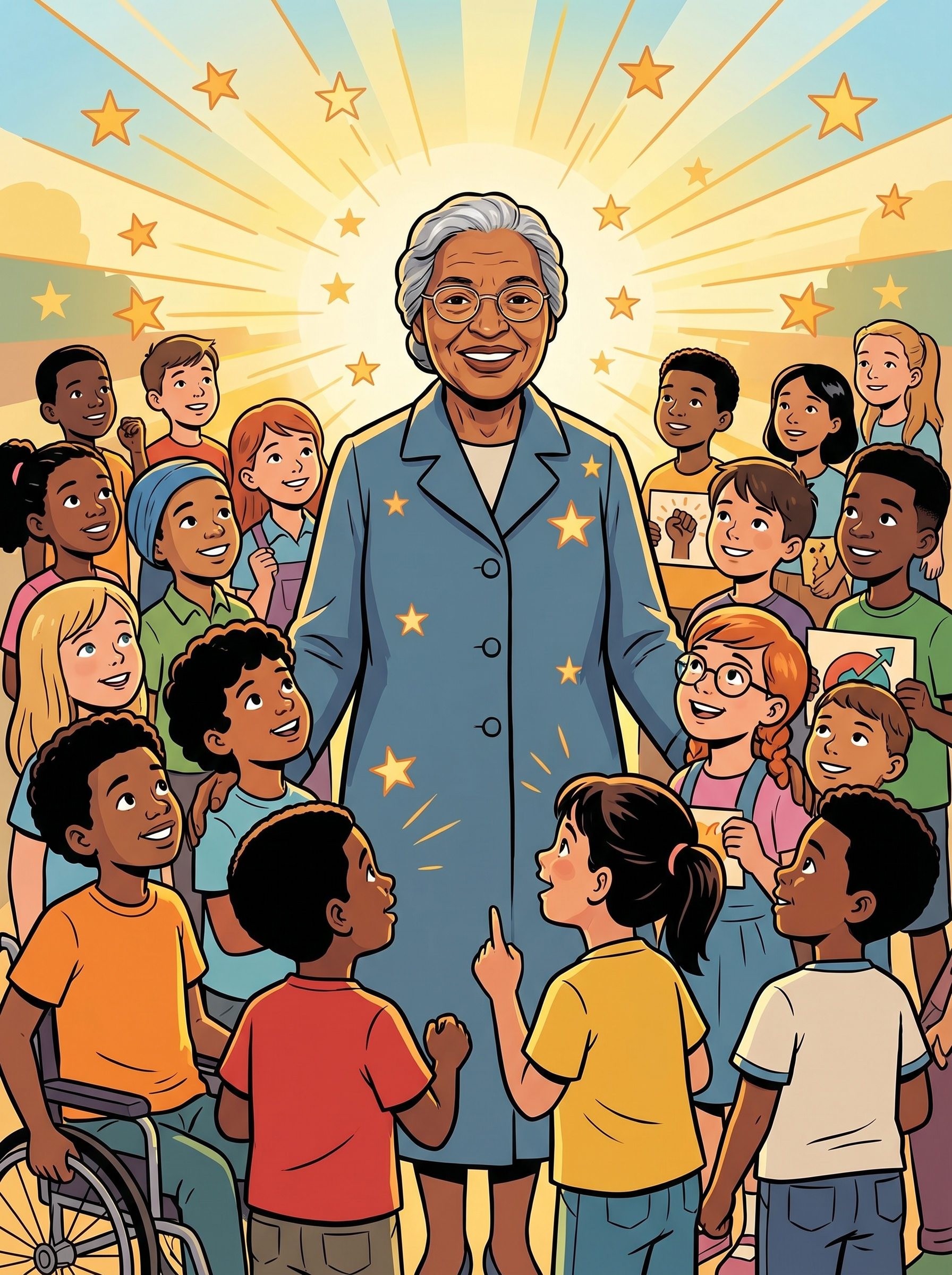
Rosa Parks' legacy and honors

📖 The Story

Rosa Parks did not stop after the boycott. She continued fighting for justice for the rest of her life. She worked with Congressman John Conyers for 23 years, helping people in need. In 1996, President Clinton awarded her the Presidential Medal of Freedom — the highest honor a civilian can receive. In 1999, she received the Congressional Gold Medal.

Rosa passed away on October 24, 2005. She became the first woman in American history to lie in honor in the U.S. Capitol Rotunda.

🗓 Timeline

1956 Supreme Court rules bus segregation unconstitutional
1965 Voting Rights Act signed into law
1996 Presidential Medal of Freedom
1999 Congressional Gold Medal
2005 Lies in honor at the U.S. Capitol

Discussion Questions

Level 1 — Who & What · Write your thoughts below. Your answers stay private on your device.
1 Rosa kept working for justice for 50 more years after the boycott. Find two specific things she did from the chapter.
🔒 Your answer is not saved to any server — it stays on your device only.
2 What does it mean when we say someone is a symbol? Why do you think Rosa became a symbol of standing up for what is right?
🔒 Your answer is not saved to any server — it stays on your device only.
Chapter 5 of 7
6

AI Bias Toolkit

🤖 Be a Critical Thinker
AI Bias Toolkit activity

📖 The Lesson

Just like Rosa Parks had a perspective shaped by her experiences, AI systems are shaped by the data and choices people make when building them. When a story leaves out important facts, or focuses only on one person's point of view, it can create a biased picture.

The "tired woman" story leaves out that Rosa was a strategic activist. Perspective is the lens through which someone sees the world. Rosa's perspective was shaped by decades of injustice. An AI's perspective is shaped by the data it was trained on.

🔑 Key Concept When a story leaves out important parts, that is called bias. Bias can be in books, news articles, and AI systems. Learning to spot it is a superpower.

Discussion Questions

Level 1 — Who & What · Write your thoughts below. Your answers stay private on your device.
1 When a story leaves out important parts, that is called bias. In your own words, what does it mean for a story to be biased?
🔒 Your answer is not saved to any server — it stays on your device only.
2 If you read a short story about a famous person and it does not feel quite right, what is one question you could ask to find out if the story is biased?
🔒 Your answer is not saved to any server — it stays on your device only.
Chapter 6 of 7
7

Harkness Table Talk

🗣 Everyone's Voice Matters

📖 How It Works

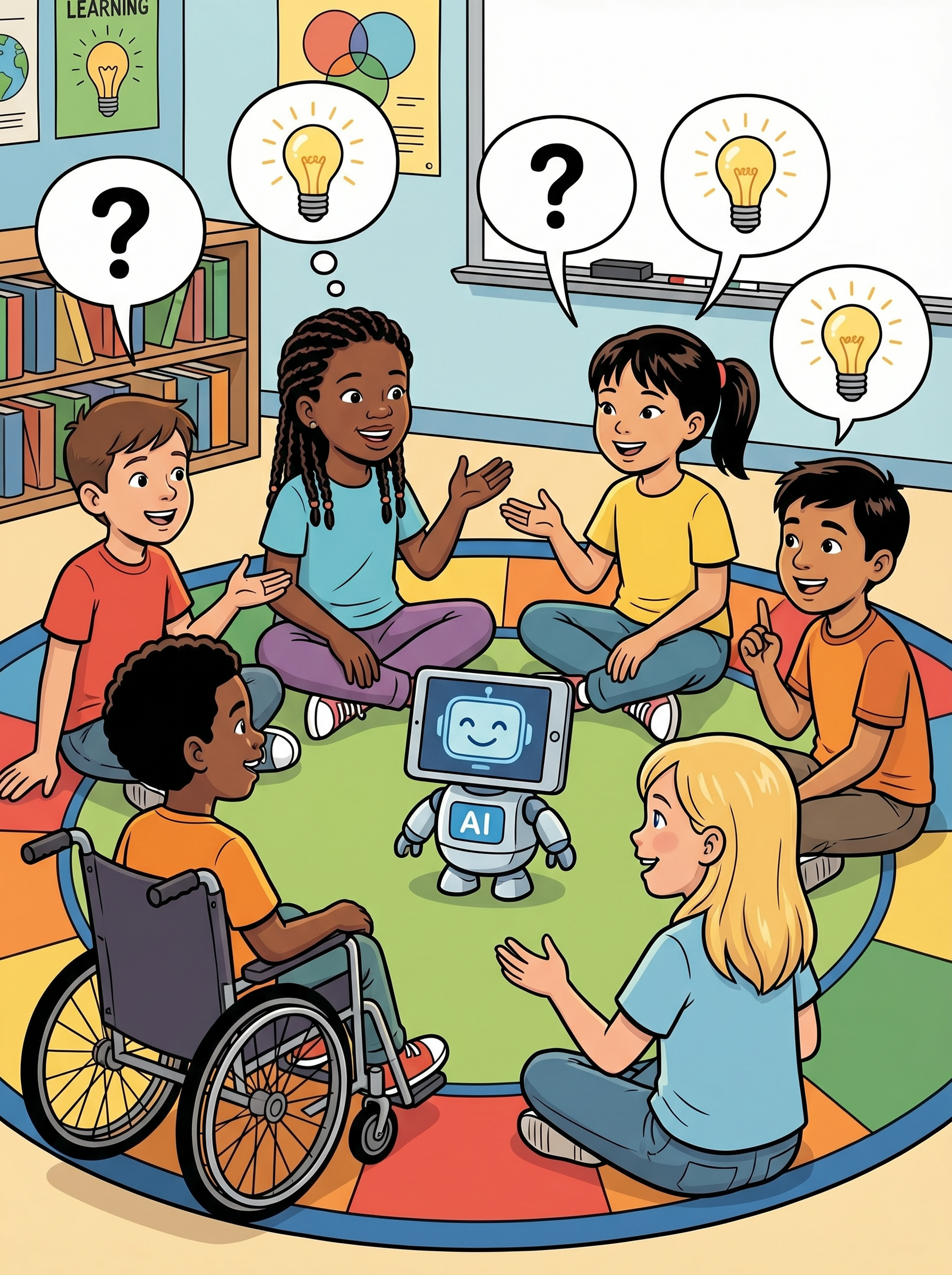
In a Harkness table talk, you speak directly to each other — not just to the teacher. The goal is to build on each other's ideas, challenge respectfully, and make sure every voice is heard. Use these sentence stems to join in:

  • "I agree with ___ because ___"
  • "I disagree with ___ because ___"
  • "To add onto what ___ said about ___, I think ___"

Discussion Questions

Level 1 — Who & What · Write your thoughts below. Your answers stay private on your device.
1 Pick one moment from Rosa's story that you want to talk about with your classmates. Which moment? Why does that one matter to you?
🔒 Your answer is not saved to any server — it stays on your device only.
2 After reading the whole story, what is one question you still want to know the answer to?
🔒 Your answer is not saved to any server — it stays on your device only.

Want the Full Interactive Version?

Contact us to bring the full interactive Civics Remix experience to your classroom — with saved responses, teacher dashboards, and live facilitation.

Contact Us for the Full Interactive Version →
Chapter 7 of 7